As we reflect on Remembrance Sunday/Armistice Day, it seems appropriate to take a look at the history of the town’s war memorial.
The aftermath of the First World War saw an unprecedented wave of public commemoration with many thousands of memorials erected across the country.
Both as a result of the huge impact the loss of three quarters of a million British lives had on communities, and the official policy of not repatriating the dead, which meant that the memorials provided the main focus of the grief felt at this great loss.
The story in Hailsham began on 28 November 1918, just 17 days after the armistice when the Parish Council met and resolved to:
“…. take the initiative for providing by public subscription a permanent memorial for the men of Hailsham who made the supreme sacrifice in the great world war whilst serving in His Majesty’s Forces upholding the cause of Freedom and Justice…”
The Council meeting was followed by a public meeting on 4 March 1919, which discussed how best the town could express their respect and gratitude for those who died in the Great War.
The decision of the meeting was that, “that a monument, together with a memorial hall, be erected in the High Street”, and that “Southview Villa in Western Road be purchased for conversion into a library and an institute for recreation.”
Subsequently land next to the old chestnut tree in the High Street for the war memorial and was offered by Mr J.S.O. Robertson-Luxford.
Additionally, J. Robert Green and Arthur Green offered to purchase Southview and present it to the council in memory of their brother Ewart V Green who was killed in action in Belgium in 1917. The library was subsequently opened in April 1920.
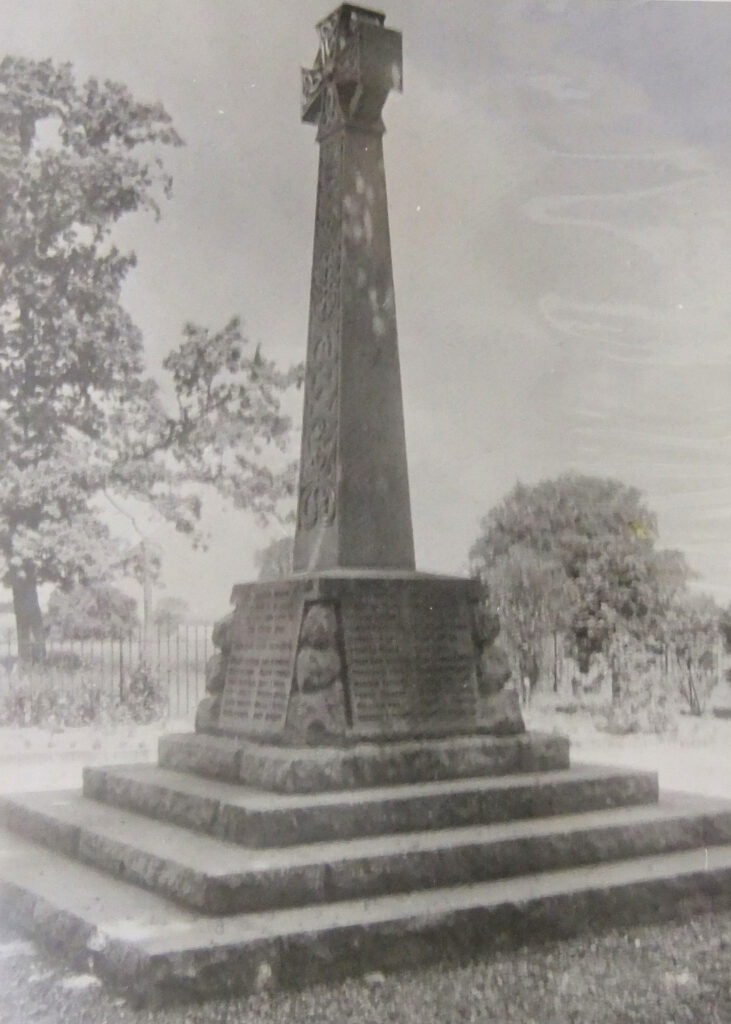
Later in 1920, the memorial was erected. It is a 4m tall Cornish granite Celtic cross with triquetra carved in relief on the arms of the cross. The cross is set on a three-step stone plinth.
The east and west faces of the shaft are carved with an interlace pattern in relief from the plinth to the base of the cross. The tapering plinth has cyclopean rustication at each corner, and sits on four rough-hewn granite steps.
The west face of the memorial is inscribed: “1914 1919 in grateful memory of/the men of Hailsham/who gave their lives in/the great war/their name liveth for evermore”. All three other faces of the plinth are inscribed with the names of the fallen.
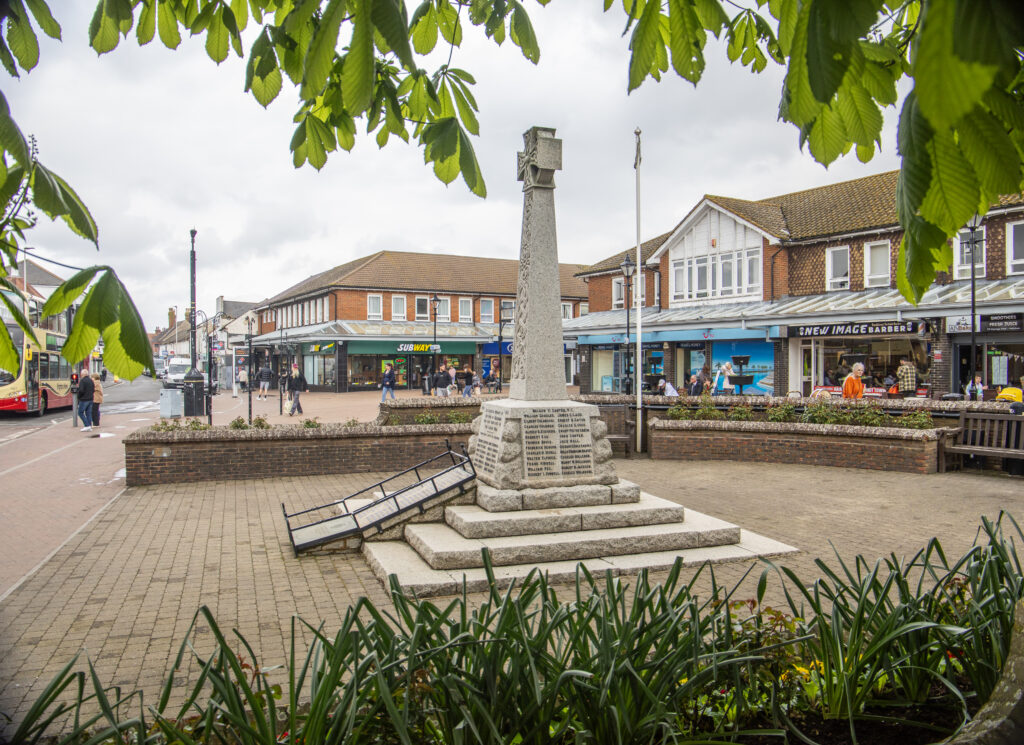
A rectangular commemorative stone slab sits on the steps on the west face of the memorial, surrounded by a shallow iron railing.
The slab is inscribed: “1939 1945, our gratitude is/given also to those brave sons of Hailsham who died to vindicate the sacrifice of their fathers/we shall always remember.”
The memorial is enclosed by a small wall which, like the surrounding shops, was not present when the memorial was erected.
The contractor for the memorial was Mr K Thornton, who agreed to do the work with his father Alfred Thornton at cost price.
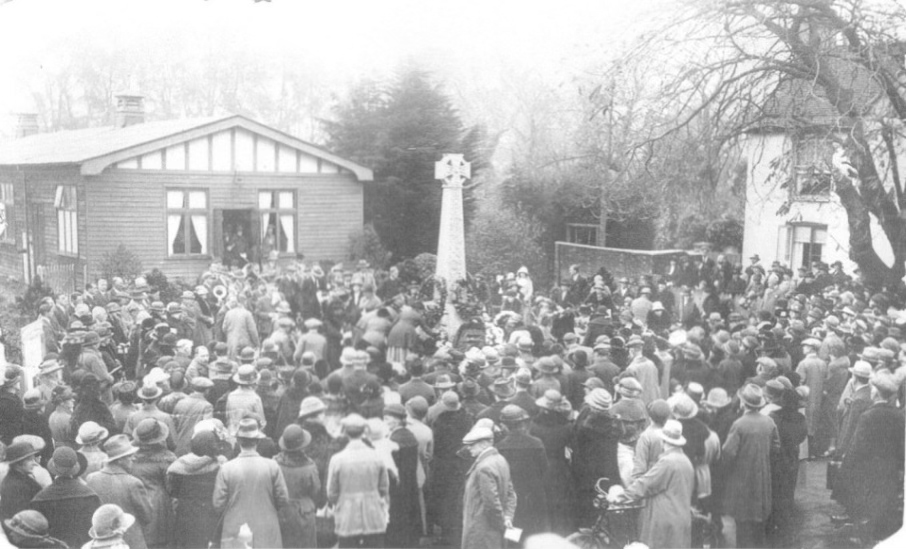
In addition to the memorial and institute, a wooden building on the army camp in Summerdown Road, Eastbourne was relocated to Hailsham and placed behind the memorial. It was named as the Comrades Recreation Hut, thereafter known simply as ‘The Hut’. It was opened on 5 February 1920.
The war memorial was unveiled later in the year on 28 November 1920 by Lord Leconfield, Lord Lieutenant of the County, with an accompanying dedication service led by Rev Preb F Clyde Harvey, Vicar of Hailsham. The contribution of women to the war effort was acknowledged in Lord Leconfield’s speech.
The Roll of Honour initially comprised 77 names, but an additional 12 names were added at a later date. Some of the later additions died of wounds after the memorial had been completed, while others (including two highly decorated soldiers) were simply omitted from the Roll of Honour.
The absence of a complete record of names was acknowledged during the unveiling, as a call for further names was issued during the ceremony.
The tablet bearing the names of the fallen from the Second World War was added to the memorial in November 1949. The memorial is Grade II listed. (Listed status protects buildings and structures of special architectural or historic interest).
A further tablet was added in 2016. This followed a decision by the government in 2014 that a memorial stone should be placed on war memorials in the birth town of those who were killed on the battle field and awarded the Victoria Cross (VC). One such was CSM Nelson Carter who was killed on 30 June 1916 following extreme bravery at the battle of Boars Head.
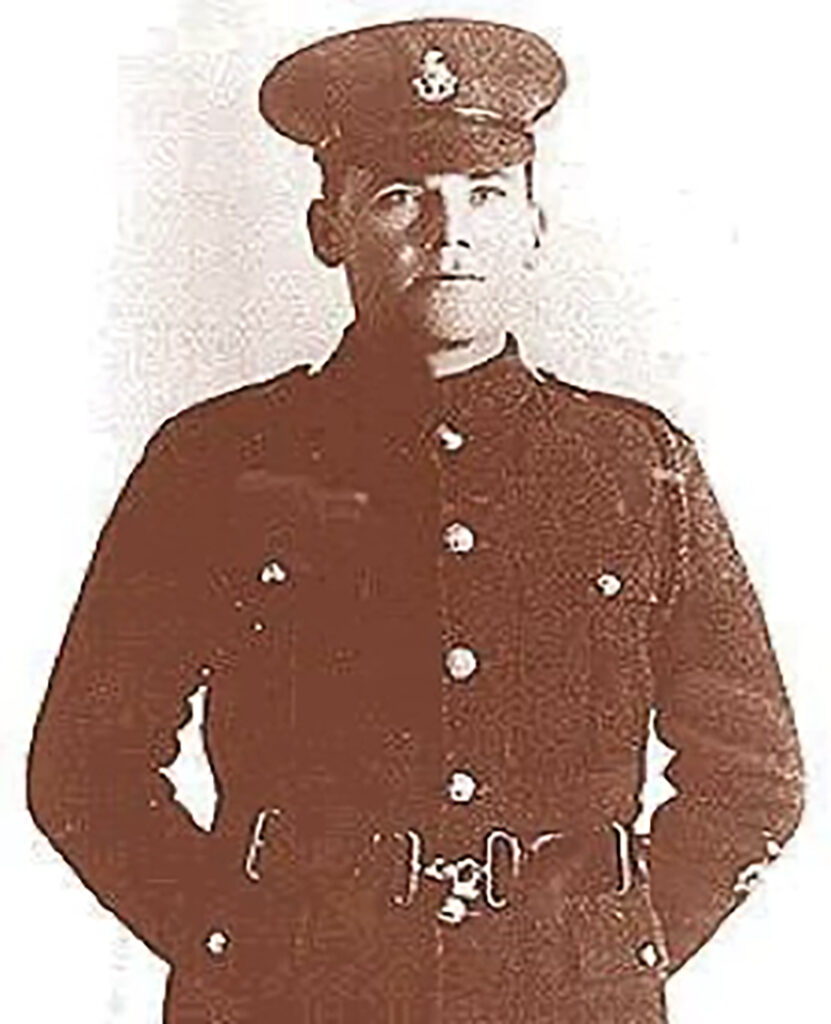
There was some dispute as to which town would be awarded the stone in memory of Carter. True, he was born in Eastbourne, but at a very young age his family moved to Hailsham and he was raised and spent his formative years in the town.
He attended Hailsham Boys School, (now Hailsham Academy). Despite the strong claims from Hailsham, the government decided to award the stone to Eastbourne. However, at this point Hailsham Town Council stepped in and had a memorial stone made which was duly unveiled on 2 July 2016.
There are other memorials in the town notably, in Hailsham Parish Church, the Methodist Church, Hailsham Town FC club house and Hailsham Academy. In addition, there are fifteen war graves, in Hailsham Cemetery which are maintained by the Commonwealth War Graves Commission ten for men killed in the First World War and five in World War Two.