
When people talk to me about crime in their communities, one issue that comes up time and again is shop theft. If we are serious about rejuvenating our high streets and town centres we need a concerted and collective effort to tackle shoplifting.
As the national lead for retail crime for the Association of Police and Crime Commissioners, I have been at the forefront of a national operation to identify organised retail crime gangs. I established the Pegasus Partnership with several of our major retailers to fund a dedicated specialist national police intelligence team called Opal. The Opal team have identified hundreds of offenders and organised gangs, leading to arrests, prosecutions, and deportations of foreign national offenders.
In Sussex, I established the Safer Sussex Business Partnership to look at how police and retailers could work more effectively together, including making reporting shop theft quicker and easier.
While every offence matters, the reality is that a relatively small number of prolific offenders are responsible for a significant amount of retail crime. That is why I launched the ground-breaking Operation STOP in East Sussex in 2025. It’s a partnership approach – bringing together enforcement and rehabilitation – to tackle persistent shop theft in a new way.
Operation STOP (Shop Theft Offender Project) combines GPS tagging, as part of Criminal Behaviour Orders, alongside tailored support for offenders to help address the complex issues that often drive their repeat offending.
Working alongside Sussex Police, East Sussex County Council, the Probation Service, Change Grow Live and the Co-op, we wanted to see whether a more focused approach could reduce crime and improve outcomes.
The results from an independent evaluation are extremely encouraging. Every one of the first eight tagged offenders included in the analysis reduced their offending, with five committing no further offences at all after being tagged. One prolific offender has remained offence-free since October 2025. Overall, offending reduced by approximately 58% – a really welcome result given the prolific nature of the cohort.
Based on these findings, researchers estimate that around 300 offences could be prevented over a 12-month period, saving up to £100,000 in costs to policing and the wider criminal justice system.
Just as importantly, local businesses are telling me they are seeing the benefits. Retailers and criminal justice partners have described a dramatic reduction in repeat offending and greater confidence that action is being taken against those causing the most harm.
What makes Operation STOP different is that it is not just about enforcement. Alongside GPS monitoring, offenders are supported by a dedicated Business Crime Navigator who helps them access housing, healthcare, substance misuse services, employment support and other interventions. The aim is simple: address the root causes of offending and help people break the cycle of crime.
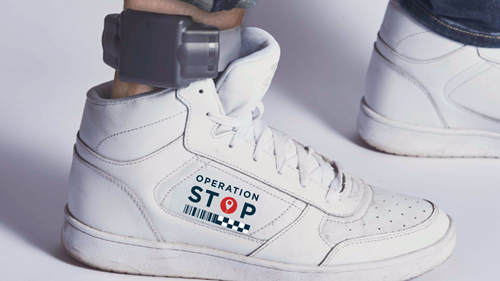
The Buddi Tag uses GPS technology to monitor the wearer’s location. It can alert authorities if the wearer enters restricted areas (such as certain retail zones or premises) and can be used to prompt support interventions if needed. The offender is required to always wear the tag and charge the tag for two hours daily. The chargers work in a similar way to a power bank, negating the need for them to be ‘plugged in’ or for the individual to wait for two hours while the device is charging.
Alternative charging arrangements can also be made for wearers that are homeless, such as attending a specific location to have their tag charged. Compensation Orders will be considered for any deliberate damage to the equipment. Strict data protection protocols are in place.
Location data is only accessed by authorised personnel and is used for the purposes of monitoring compliance, identifying any further possible offences and providing support. The Buddi data is accessed through a secure website, approved for use by Sussex Police.
The website platform enables the user to set the restrictions and set criteria for alerts. Alerts can be set up for a wide variety of incidents and scenarios such as low battery, a possible attempt to remove the tag or block the signal from the tag and breaches of the exclusion zones.
We are still learning as the project develops but the early signs are very positive. The success of the East Sussex pilot has already led to an expansion of the scheme across Sussex, increasing capacity from 10 GPS tags to 30.
I firmly believe communities deserve both safer high streets and solutions that prevent crime from happening again. Operation STOP is proving that by combining accountability with support, we can protect local businesses, reduce reoffending and help build safer communities for everyone.