Hailsham market was first held in 1252 when Henry III granted a royal charter: “to our dear and faithful Peter de Savoy and his heirs in perpetuity to have a market in his manor of Heylesham every week on Wednesday.”
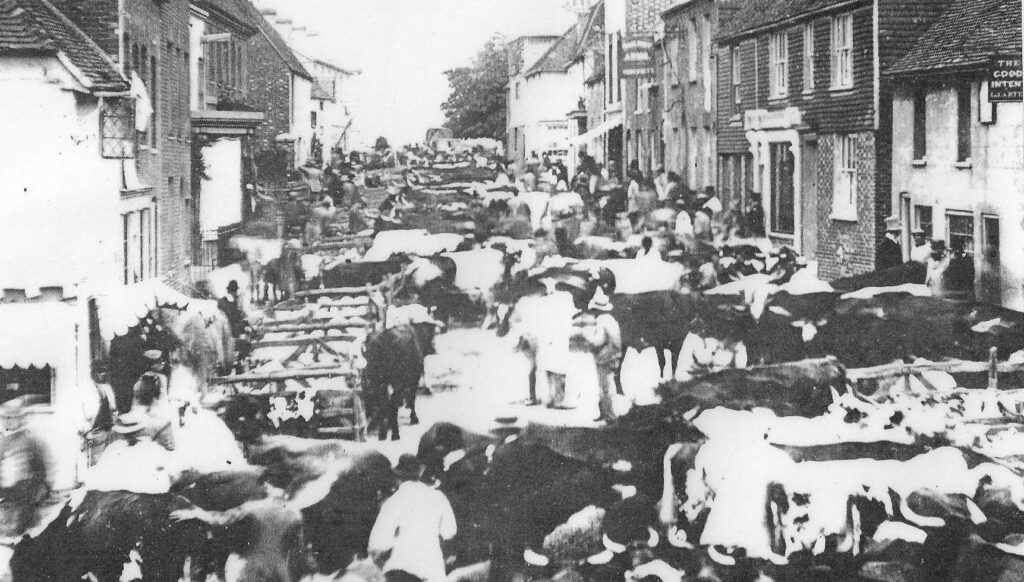
This market met until 1639, when it was discontinued, but restarted in 1786 and until 1868 was held in the High Street, spreading into the surrounding streets including the Market Square.
In the mid-15th century, Hailsham market was very busy and prosperous, resulting in an extensive tanning trade and from about 1540 to 1640 Hailsham was one of the chief centres for tanning, employing several tanners and leather workers.
A market cross (similar to the one which still exists in Alfriston), was erected in the square. The purpose of the cross was to make sure all deals were seen to be done, “in the sight of the Lord.”
The cross was removed in about 1800 to allow carts to turn the corners of the roads leading to the square. It is recorded in the Church Registers that on 30 March 1603, James I – King of Scotland –“wast proclaimed King of England in ye town of Haylesham.” This declaration took place in the Market Square. It was also in front of the Market Cross that Banns of Marriage were ordered to be proclaimed during the time of Cromwell, rather than in church.
In 1868, when the market moved to the present site in Market Street, auctioneering was introduced, something which was not welcomed by the farmers as they had to pay the auctioneer a commission.
The market quickly developed, and it is known that Welsh farmers brought their cattle for selling at Hailsham. The 1870 edition of Kelly’s Directory described Hailsham Market as, “one of the largest in the shire.”

Today the cattle market meets weekly and is now the only live cattle market in Sussex. Additionally, there is an open market on a Friday which is now largely a Boot Fair.
Standing in Market Square is Sherriff’s House, which was originally the home of Anthony Trumble, Under/High Sherriff of Sussex who died in 1733. The original part of this property was built in Tudor times c1710 and later became a grocer’s shop, opened in 1816 by Thomas White.
He was followed by his son, Daniel who was described as a “wholesale and retail grocer, tailor, draper, hatter, wine and spirit merchant, purveyor of china, glass and earthenware and agent for the Norwich Union Fire & Life.” He was also responsible for issuing a range of government licences. The shop continued in the hands of the White family to the fourth generation until 1946 when Harry White retired. Today the premises are occupied by The Laurel café and the Quicken Trust.
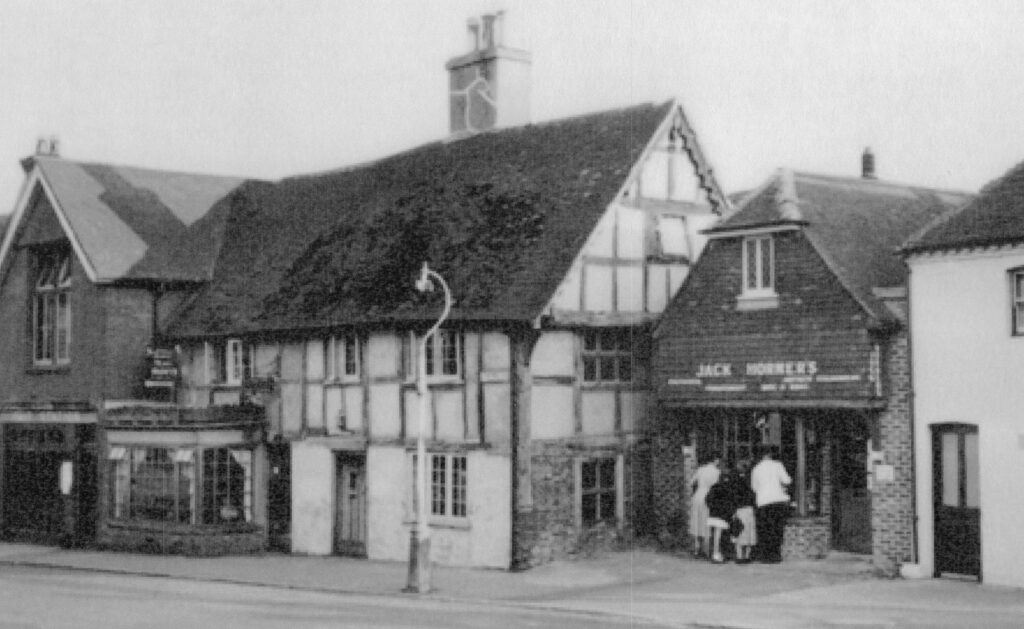
Just along the road down Market Street is Fleur de Lys, which was originally built in 1540 as an inn and was the terminus for coaches between Hailsham and London. Later, in 1762, it became the Poor House.
In 1836, a national system of Poor Law Unions was established. The Unions were groups of parishes which provided jointly for the poor in their area. In Hailsham this resulted in the building of the New Union Workhouse in Hawks Road at the junction of Hellingly and Hailsham parish boundaries (serving the needs of 12 parishes). Fleur de Lys was later divided into two; one end being used as the Post Office and the other as an undertaker’s and wheelwright’s shop.
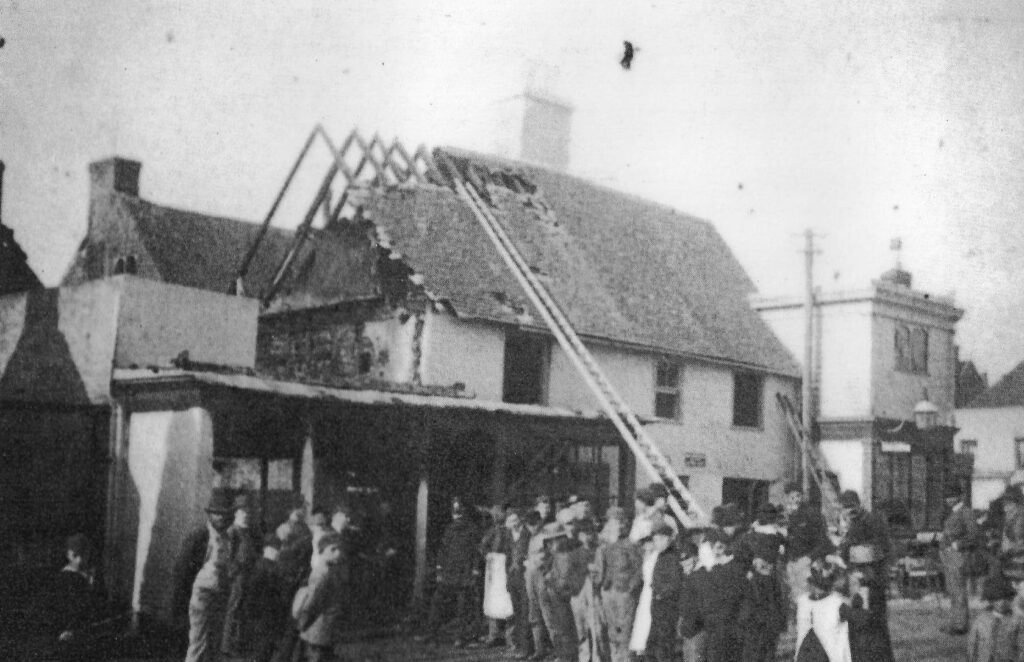
In 1889, there was a fire and part of the building destroyed. The Post Office was repaired and became a private dwelling. The rest of the building was demolished and a new building erected, which became the Fire Station, until the present station in Victoria Road was opened in the 1960’s. The Post Office moved to North Street in 1908 and has had several moves since! Fleur de Lys has also been a butcher, confectioner, and numerous other shops, including a tea shop. Today it is home to Hailsham Town Council.
Behind Fleur de Lys is the Hailsham Heritage Centre, open May – October on Fridays & Saturdays, 10.00am – 12.30 pm. The Centre has interesting displays of memorabilia and photographic displays reflecting the history of the town. Admission is free.
Beyond this is Kingscote, until recently the premises of Lloyds Bank. Further along Market Street is Southerden House. At one time this building was The Cow Beer Shop. Next is the Old Manor House. Charles Robertson in his book “Hailsham and its Environs,” describes it as, “an exceptional house built almost entirely of brick with the architectural ornament and classical design of the late Renaissance period.”
Robertson adds that the design of the house is one “little seen near Hailsham.” In the 1920’s there were Tea Rooms in the garden at the rear. Further along is the Old Vicarage, which was built about 1745.
Finally, there is the Baptist church, which was built early in the 19th century. The Baptists started meeting in 1792 when eight people met in a barn close to the parish church. By 1795 they had purchased a plot of land in South Street, later renamed Market Street, where they built a small chapel made of wood.
This was subject to an arson attack and was destroyed soon afterwards. However, the members erected a new building which was attached to a farmhouse. The church was virtually rebuilt in 1905, reopening in 1910 after extensive repairs and alterations.