AN impressive structure of scaffolding has been put up at Hailsham Parish church to allow workers to start to future proof one of the famous Pinnacles.
Ken Thoman, The Premises Manager of Hailsham Parish Church gives Hailsham News and unique insight to the history of the iconic building.
The tower, which is 65-feet high to the top of the parapet and over 90-feet high to the top of the weathervane, is a landmark that is visible from miles around.
The masonry of the tower is unusual, with an attractive chequerboard pattern of alternating sandstone blocks and small panels of flint.
There are no records of the construction of the current church, but experts date it to between 1425 and 1450, and there is a record from 1475 of a bequest from a Thomas Riche for the bell tower so the tower is likely to have been completed by around 1500, making it over 500 years old.
There are now eight bells in the church tower, and the largest, which weighs nearly half a tonne, and two others, were cast in 1663, most likely at “Bell Banks” near the common pond.
This is the second church building on the site, as there are vestiges of an earlier building, and records show there was a church in Hailsham in 1229 and that it was probably founded between 1170 and 1200 – meaning that the people of Hailsham have worshipped God here for over 800 years!
The source for some of the stone for the church and tower was probably a foreshore quarry in Eastbourne. This type of stone, which stretches in a long arc across the south of England, is known by geologists as Upper Greensand.
It was popular because it is easily shaped into blocks for arches and other features. However its durability varies greatly depending on its source, and unfortunately the stone from Eastbourne tends to weather badly.
Other stone used has been identified as Wealden sandstone that was quarried from local sources, possibly including from Quarry Pond, opposite Hailsham cemetery. This stone varies considerably in colour, from pale cream and pink to dark brown and fortunately is generally much more durable.
Many repairs to the tower have taken place over the years, and most recently in 1962 when all four pinnacles were repaired at a cost of £705. The old photo shows that work in progress, and that at the same time the clock faces were also removed so they could be renovated.
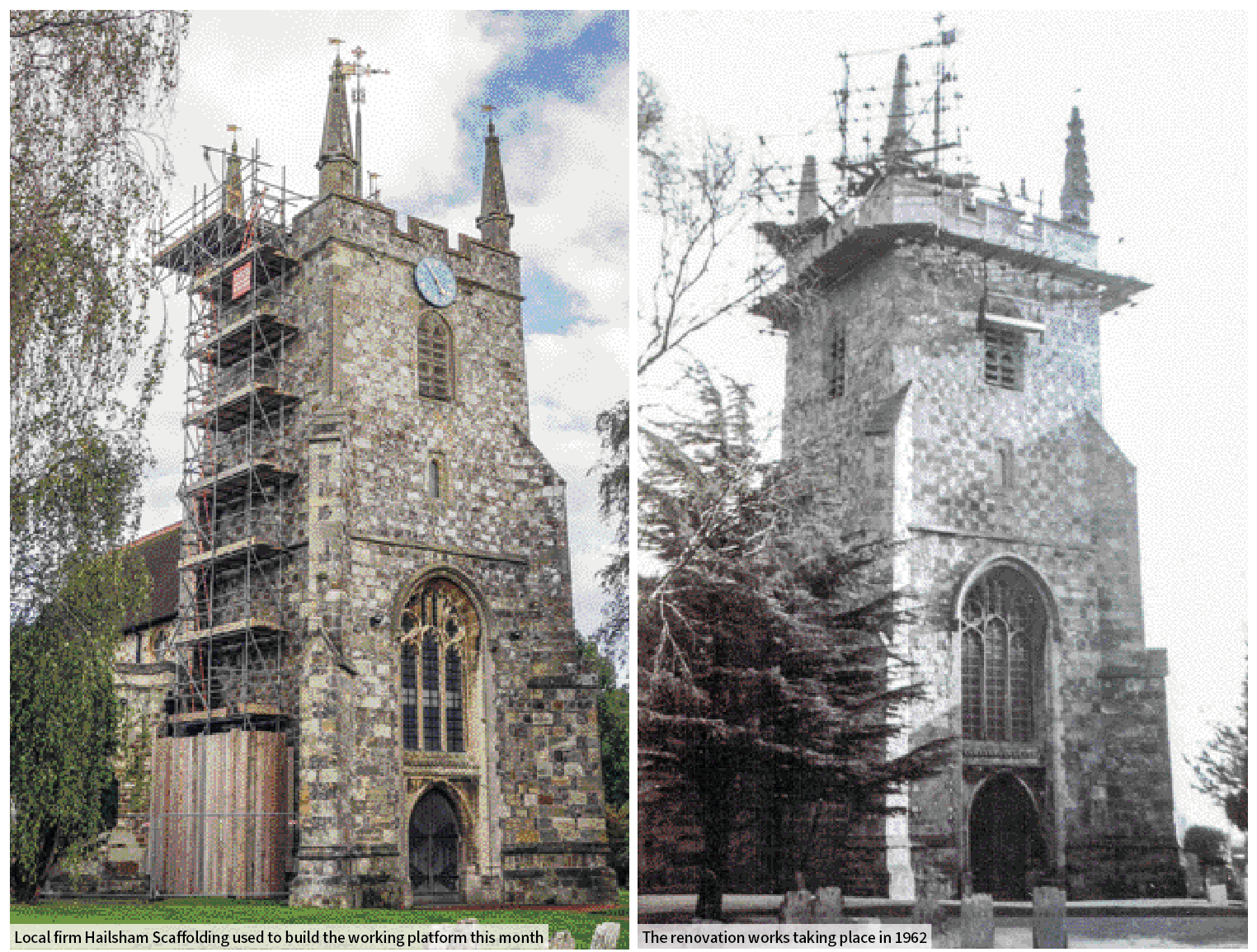
The scaffolding used was very different, being suspended from the top of the tower, and this suggests that the safety regulations were rather different 60 years ago! The church at Hailsham receives no funding from the Government or central church sources and all repairs have to be funded locally by gifts and legacies from the congregation.
To minimise the cost of the repairs at that time, the stone was re-faced and stabilised using a layer of special mortar, and the work was carried out by the firm of Tilley’s from Brighton.
Also apparent from the photo is that the decorative stone carvings on the pinnacles (called crockets) sadly had to be removed because they were becoming unsafe.
These repairs mostly remain in very good condition, but on the north-eastern pinnacle some of the mortar facings are beginning to crack.
This time, around twenty complete blocks of damaged stone will be replaced to achieve a more permanent repair.
The new stone is the same type of Upper Greensand as the original, but a particularly durable version which is still quarried in Wiltshire.
Following a tendering process, Tilley’s, now run by the grandson of the founder, are back to do these repairs, which are costing £13,500.
The works are expected to be completed by the end of the month.